Thursday, February 27, 2014

How To Treat your Acne?

On my last few posts, you have learned, what is acne? the types of acne, Acne treatments/medications and now I'm going to inform you how to treat acne and what to do as a start to maintain it under control.

If you are starting to struggle with acne, this information may help you to maintain acne under control. On the last post, I shared with you information regarding the different acne treatments/medications and I mentioned two over-the-counter medications that have been proved to be effective against acne. Those were: saliclyic acid and benozyl peroxide.

Those medications, you can find them almost anywhere, especially on the most marketed brands such as Neutrogena, Clean and Clear, Proactiv, Murad, Exposed skin, Acne Free, Noxema and more.  

My personal experiences have been with Neutrogena, Proactive and Clean and Clear, but I have had good word from Murad and Exposed Skin.  Neutrogena and Proactive have been my back ups in case I couldn't get hold on my medications, either because I don't have the money to get hold of them or my medical plan had been cancelled.  They both have been able to hold the fort for a little while, but my acne type is stronger, so my face starts to flare up with acne.

Photo by shescribes.com

Like at this moment, since my recent medical plan was cancelled by my employer because of Obama Care, now I have to wait for at least 30 days to get my new medical card, until then I can't get hold of my medications, because of how expensive they are.  Once I get my new medical plan, I'll get my medications, because it had proved to be more effective for me to my type of acne, than the over-the-counter products.

Just for you, who may be wondering what are the medications I've been prescribed by my dermatologist, this are "epiduo" (which contains 2.5% benozyl peroxide with 0.1% adapalene) and "aczone" (which containes 5% dapsone) this are both topical medications and they have been great to my type of acne, my skin today is flawless.  I may get once in a while one pimple, but that is something normal, even people with perfect, flawless skin gets one.

So now, let's stop the talking and go to business.  Below I'll give you some recommendations by my experience and by recommendation given to me by dermatologists through the years treating my acne:

Hygiene is very important for acne prone skin. If you suffer of acne in your face, back, shoulders, chest, stop using soap that could clog your pores and do not scrub it, very important.  Also, stop washing your face or body more than twice a day, why, because overwashing and scrubbing can cause skin to become irritated. Believe me when I tell you it will make your acne worst, I'm telling you by experience. 


Photo by Loveolia.com

  • The American Academy of Dermatology recommends using oil-free soap or cleansers that contains benozyl peroxide or salyclic acid to treat acne for your face and body.  You could definitely get this over-the-counter.  By my experience I have used to wash my face Cetaphil, Neutrogena Oil-Free Acne Wash/Cream Cleanser 2.5%, Proactive face acne treatment 2.5% Benozyl Peroxide, and Proactive face acne treatment 2.5% Benozyl Peroxide and Clean and Clear 10% Benozyl Peroxide (this one had been to harsh for my skin).  For the Body: .Neutrogena Body Wash, Panoxyl 10% benoxyl peroxide for the body and Proactive face acne treatment 2.5% Benozyl Peroxide.
  • When you go buy a face wash, please make sure is Oil-free. To start an acne treatment, it's preferably if it contains, Benozyl Peroxide or Saliclyic acid and wash your face twice a day.  If you see it irritates your face to much, then reduce it to once a day instead, until your skin gets use to it.  
  • Get a acne treatment medication cream preferably containing benozyl peroxide, since it's purpose is to kill the acne bacteria.  You can put it on, after you cleanse your face with the acne wash or oil free wash.  It is recommended to put on twice a day, before you go to bed and in the morning for best results. But, if it irritates to much, use it once a day.
  • Get yourself a Oil-free moisturizer for your face and body to maintain it hydrated.  I prefer cetaphil, because it's gentle to my skin. You can use another brand, but make sure is oil-free.
  • For girls, use make-up that is oil-free foundations and "won't clog pores", "non-comedogenic", "non-acnegenic" powders, blushes or anything that you may put on your face. Wash the make-up brushes constantly.  I use, baby shampoo for it. Also, VERY IMPORTANT remove your make-up and wash your face before you go to bed and do your routine.
  • DON'T POP THE PIMPLE! I know how frustrating it is, but it's something my dermatologists told me all the time and my scars are prove of it. It's a bad idea... you pop it it can come back worst, your skin gets scarred and it can get infected, which then the heal process is longer. I know it sucks, but believe me, it's a big no no.
  •  DON'T touch your face or pimple with your hands, rubbing it makes thing worst and spread the bacteria.  LEAVE IT ALONE. Try to use your phone on speaker, or use hands-free devices such as Bluetooth's. Also, make sure to wash your hands before you wash your face, or when you put any type of cream or make-up on your face.
  • If you wear glasses or sunglasses, make sure you clean them frequently to keep oil from clogging the pores around your eyes and nose.
  • If you get acne on your body, try not to wear tight clothes. They don't allow skin to breathe and may cause irritation. Scarves, headbands, and caps can collect dirt and oil, too.
  • Keep hair clean and out of your face to prevent additional dirt and oil from clogging your pores.
  • Protect your skin from the sun. It may seem like a tan masks acne, but it's only temporary. A tan may worsen your acne, not improve it. Tanning also causes damage to skin that will eventually lead to wrinkles and increase your risk of skin cancer.
Acne treatments, take around 12 weeks before you see results and it can also get worst during that period, but don't give up.  If you see, things may not be working and you see your acne breakouts don't seem to stop after that period, my recommendation is to go visit and search the help of a dermatologist, believe me they can help find the best treatment for you.

Source:
http://kidshealth.org/

Hopefully this article can be useful and helpful for you to treat your acne.

Big hug,
Allie


Wednesday, February 26, 2014

Acne Treatment Medications

Photo by Dreamstime.com

Did you know that actress Cameron Diaz struggles with acne?? Even famous people struggles with this. And of course like us, she has also a routine to treat her acne.

When you struggle with acne, your best way to fight it and to mantain it under control is by having a regimen and acne treatment.  Everyone has different reactions towards all acne treatments.  Some of you, including myself, have sensitive skin and some of those medications may be to harsh for us, so in some cases, you will need to go back and fourth, looking for the best acne treatment for you.

In most cases, this may be overwhelming and frustrating, believe me I have been there.  I have used all types of over-the-counter products, before I found out that my best option was to reach out to a dermatologist and even with them, we had to make a few changes, until we finally found which medications were best for me and treat my acne.

Just a heads up, once you start an acne treatment regimen, your acne may get worst before it gets better.  It takes at least 12 weeks for it to get better, so don't give up, keep doing the regimen at least for those 12 weeks.  I know it's a long time, but that's the only way to know if the medication works on you.

According to Webmed.com, medicines to treat acne can help manage the severity and frequency of acne outbreaks. A number of medicines are available. Your treatment will depend on the type of acne you have (pimpleswhiteheads, blackheads, or cystic lesions). These medicines improve acne by:
- Unplugging skin pores and stopping them from getting plugged with oil (tretinoin, which is sold as Retin-A).
- Killing bacteria (antibiotics).
- Reducing the amount of skin oil (isotretinoin).
- Reducing the effects of hormones in producing acne (certain oral contraceptive pills for women).
The best medical treatment for acne often is a combination of medicines. These could include medicine that you put on your skin (topical) and medicine that you take by mouth (oral). Or you may take medicines such as clindamycin/benzoyl peroxide, a gel that contains 2 topical medicines.
Treatment of acne depends on whether inflammation or bacteria are present. Some acne consists only of red bumps on the skin with no open sores (comedonal acne). Topical creams and lotions work best for this type of acne. But if bacteria or inflammation is present with open sores, oral antibiotics or isotretinoin may work better.

There are different acne medications, some are sold over-the-counter and others are prescribed by a dermatologist.  When I say over-the-counter, it means you can get them online, on a pharmacy, a supermarket, beauty store etc.. you don't need a prescription to get them and they are more affordable than the prescribed ones.

Photo by hpnotiq.com

Below, The most common types of medicines that doctors use to treat acne:

Benozyl Peroxide: This medication can be found over-the-counter and his function it's to kill the acne bacteria. Benzoyl peroxide is generally an inexpensive treatment, and the generic products work just like the name brands do. Benzoyl peroxide is often the first treatment choice for those suffering from mild to moderate acne.

Acne cannot live in an aerobic (oxygen-rich) environment. Benzoyl peroxide works by introducing oxygen into the pore, thereby killing P. acnes. When the bacteria population is reduced, the number of breakouts on the skin is reduced as well.
Another factor that makes this treatment so effective is its ability to help rid the follicle of excess dead skin cells. Clearing the pore of cellular debris will lessen the chance of pore blockages, or comedones. So, benzoyl peroxide helps prevent breakouts before they start.
Saliclyic Acid: is a beta hydroxy acid commonly used to treat comedonal or non-inflamed acne. It is a popular ingredient in many over-the-counter products. Salicylic acid is found in lotions and creams, cleansers, medicated treatment pads, solutions or "toners." 
Salicylic acid is especially helpful in treating acne because of its ability to penetrate the follicle. It encourages the shedding of dead skin cells from within the follicle, helping keep the pores clear of cellular debris. In this way, it reduces the number of pore blockages and breakouts on the skin.
Topical and oral antibiotics: If over-the-counter treatments like benzoyl peroxide and salicylic acid aren't improving acne antibiotics may be suggested by your doctor. Clindamycin and erythromycin are the most commonly prescribed antibiotics for topical acne treatment. Tetracycline is used less often. Topical antibiotics come in a variety of forms, including lotions, gels, pads (pledgets) and toner-like solutions. In addition, topical antibiotics can be found in medications containing other acne treatments such as benzoyl peroxide or Retin A (tretinoin).
Just like oral antibiotics, topical antibiotics inhibit the growth of bacteria. A chief cause of acne is the proliferation of the acne-causing bacteriaPropionibacteria acnes (P. acnes). This bacterium is an ordinary resident of the skin, but in those with acne the P. acnes population grows out of control. These bacteria irritate the skin's follicles, creating inflamed papules and pustules.
Applying a topical antibiotic reduces the amount of P. acnes, and helping to control acne. Because P. acnes create inflammation, topical antibiotics work best forinflamed acne, rather than non-inflamed blemishesor blackheads.
Topical retinoid medicines: Topical retinoids are a group of medications derived from vitamin A. They are used to treat both inflammatory and comedonal acneTopical retinoids work by speeding up cell turnover, sloughing away dead skin cells. They help to prevent comedones which, in turn, reduces the amount of inflamed blemishes too.
If you used topical retinoid to treat your acne, you might also get some additional benefits. Topical retinoids can make enlarged pores, or follicular prominence, less obvious. They are also used as anti-aging treatments, which is good news for many adult acne sufferers. Topical retinoids can also be found in combination with other acne treatment medications. These combo treatments give you the benefit of treating acne in different with just one application.

Isotretinoin: commonly referred to by the brand name Accutane, is a powerful systemic drug used to treat severe inflammatory acne. Isotretinoin is classified as a retinoid, made from a synthetic form of vitamin A. It is taken orally, in pill form, once or twice daily.


Isotretinoin works by shrinking the sebaceous glands within the dermis, reducing the amount of oil produced. The exact mechanism of this is still unknown. The reduction of oil within the follicle means less clogging of the pores, leading to a reduction of overall breakouts.

Isotretinoin has become one of the most effective treatments available for patients with severe or cystic acne. It is even successful in clearing acne that has not responded to other treatments. 

The decision to begin taking isotretinoin is something you must discuss with your dermatologist. Because of its potency and possible side effects, isotretinoin is reserved only for those with severe inflammatory or cystic acne that has failed to respond to other treatment options. All patients taking isotretinoin are kept under careful monitoring by their doctors.

Hope this information is of good help and knowledge about the acne medications.

Hugs,
Allie
Source:
webmed.com
acne.com


Monday, February 24, 2014

Teen Acne vs. Adult Acne


Must of us, dealt with little to no acne during our teenage years, but suddenly has a flare up of acne now on their 20's, 30's and even 40's or the other way around.  To help you deal with acne at any age, I'll explain the difference between Teenage acne vs. Adult Acne.

Teen Acne:


Short Film "Reflection" Character Pizza

Teenage breakouts occur mostly on the forehead, nose and chin known as the T-Zone.  The teenage it's caused by the hormonal fluctuations that are common during the puberty period.  Once the puberty period is over, the acne often disappears.

The teen acne, appears as blackheads, whiteheads, pustules or cystic acne and it also responds pretty well with over-the-counter acne treatment options, such as Benozyl Peroxide and Salyclic Acid.  But if you see your acne is not responding to the over-the-counter treatments after 12 weeks of use, I recommend to visit a dermatologist.

Also, according to healthyskinportal.com, teenagers typically have oily skin, which the over-the-counter acne solutions are geared toward this skin type.  While this may work for the majority of the teenagers, this treatment may be harsh for the adult skin that tends to be drier and more sensitive to this acne treatments.

Adult Acne:


Adult Acne in someway differs from the Teen acne and it usually appears caused by the following characteristics.

The breakouts are most common on the lower part of the face (like the cheeks), including the chin and jaw line.  It may be due to the hormonal fluctuations of menstrual cycles, pregnancy or menopause and a lot of stress.  In addition to blackheads, whiteheads, pustules and cystic acne, adults may develop a form of Rosacea with their acne breakouts.

According to healthyskinportal.com, the over-the-counter acne treatmens such as benozyl peroxide doesn't have the same positive effect for them.  In addition to killing off the bacteria that causes acne, their substance also accelerates the effects of aging on the skin and can irritating causing the skin to dry.  So, instead of using over-the counter, most adults are turning to cosmetic procedures that are effective at keeping acne breakouts at bay, such as macrodermabrasion, chemical peels, laser skin resurfacing and smoothbeam laser treatment.

And also adults tend to turn to their dermatologist or cosmetic surgeons for help.  Acne can be embarrassing for all ages, but I consider is more embarrassing when you are an adult.  The good news is that acne can be controlled.  There are many options to maintain it at bay and feel better about yourself.  

Hope this information is for help for you to better understand your acne.

Source:
healthyskinportal.com
www.reflectionshortfilm.com


Saturday, February 22, 2014

What's Acne and what causes it???

The million dollar question, what's acne and what causes it?  Believe me, I have surfed through all the search engines looking for a definition and a solution for it, so I'll put it to you as simplest as I can, because I know how overwhelming and stressful it can be.

Acne, according to thedictionaryfree.com is "an inflammatory disease of the sebaceous glands and hair follicles of the skin that is marked by the eruption of pimples or pustules, especially on the face."


That's good to know, but what does "sebaceous glands" or "hair follicles" means? Just in case you were asking yourself that: 


"Sebaceous glands" are the small glands in the skin that secrete sebum(oily substance, which main purpose is to make the skin and hair waterproof and to protect them from drying out) into hair follicles and onto most of the body surface except the soles of the feet and the palms of the hands.


"Hair Follicles"  is a mammalian skin organ that produces hair. Hair production occurs in phases, including growth (anagen), cessation (catagen), and rest (telogen) phases. Stem cells are responsible for hair production.


Now we know what acne means and on that sentence it mentions two of the main causes of how acne starts: Sebacous glands and hair follicle. 

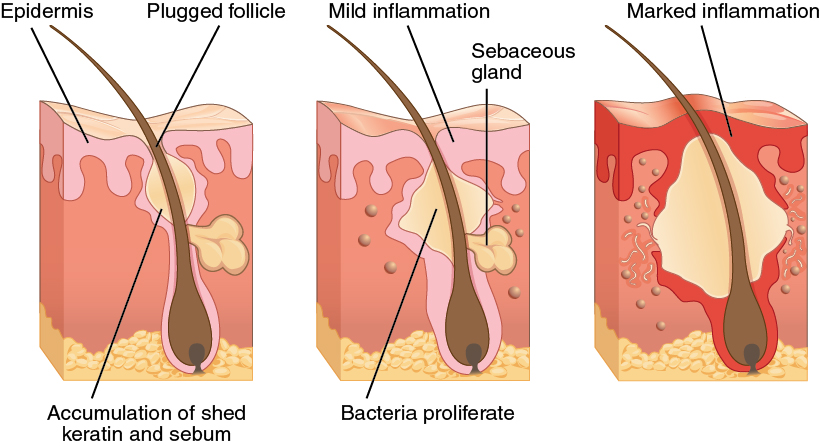
Acne occurs when the hair follicles become plugged with oil and dead skin cells.   Hair follicles are connected to sebaceous glands. These glands secrete an oily substance known as sebum to lubricate your hair and skin. When your body produces an excess amount of sebum and dead skin cells, the two can build up in the hair follicles and form together as a soft plug, creating an environment where bacteria can thrive.

This process causes an inflammatory response seen as papules (red bumps), pustules, and nodules. The bacteria also cause the formation of free fatty acids, which are irritants, increasing the inflammatory process in the follicle.


Normal Follicles
Sebum produced by the sebaceous gland combines with cells being sloughed off within the hair follicle and "fills up" the hair follicle. When the follicle is "full", the sebum spreads over the skin surface giving the skin an oily appearance. When this process works correctly, the skin is moisturized and remains healthy.
Obstructed Follicles
Problems arise when the sebum is trapped in the hair follicle. For reasons that are still unclear, some hair follicles become obstructed. The sebum is produced but gets trapped on the way out, and the cells that are normally sloughed off become "sticky", plugging up the follicle. The process of obstructing follicles is called comedogenesis. It causes some follicles to form a type of acne called comedones, also known as blackheads and whiteheads.


Hope this information helped you in understanding what causes acne.  It definitely helped me.

Sources:
mayoclinic.org
About.com
commons.wikimedia.org
youngwomenshealth.org


Acne is the #1 skin disorder in the US


Did you know that 40 to 50 millions of US citizens hav acne? Making it the #1 skin disorder. This is according to the American Academy of Dermatology.  The American Academy of Dermatology also says that 85% of all people had experience acne at some point of their life either on their face, chest or back.
And because of this statistics, acne treatment is considered one of the most lucrative business in the US.  I found this interesting while reading the article by medpage today called "Guideline$: Following the Money in Acne Treatment" where it says that in 2012, the top 5 prescription drugs for acne treatment made $1 billion dollars in revenues.  This acne treatment medicines range from $100 to $800 if you have to pay out-of-pocket and this are the gels or creams, if we talk about oral pills, by experience they can cost from $500 to almost $2,000.
The reason of why this acne treatment medications cost more according to medpage today is because this medications have combined two active ingredients to fight acne making it much more convenient for the patients to apply it once a day, instead of twice a day as a daily routine. And as proof, the guidelines cite a 12 week clinical trial that showed that is more effective the combination of medications to fight the bacteria, than applying the medication separately.
I also found out that, some of this active ingredients that fight acne like for example Benozyl Peroxide and Clyndamycin gel, if sold separately they may cost you $140. So that may be an option for those who can't afford the combine medication, because either they don't have a medical plan or a plan that just provides discounts on medication and have to pay for our medications out-of-pocket. Ask your Doctor about this option.
Now that you have read all this information don't freak out, there are many ways for you to get your hands on this medications without spending more than $30 or in some cases no more than $150 dollars.  Believe me I have used the majority of the top 5 acne treatment medications and I have been able to afford them and you may also.
So please if you have moderate to severe acne, get it treated with a professional.  If you don't have health insurance the cost rate for a Dermatologist office visit ranges from $80-$110 or even less depending on your area, so do your research. Sometimes they have specials, where the first visit is for free, it doesn't hurt to ask.
Also, by experience after my visit with dermatologists, when she or he gives me a prescription of the medications to use, they give me samples of those medications and also prescription cards or coupons to reduce the cost of the medications.  So make sure to ask for them after your visit, it will save you hundred of dollars.
If you have any questions, concerns or something you would like to also share with us please comment below. Also, stay tuned I'll be publishing a page which will I provide you with coupons to save hundreds of dollars in your medications.