Acne, according to thedictionaryfree.com is "an inflammatory disease of the sebaceous glands and hair follicles of the skin that is marked by the eruption of pimples or pustules, especially on the face."
That's good to know, but what does "sebaceous glands" or "hair follicles" means? Just in case you were asking yourself that:
"Sebaceous glands" are the small glands in the skin that secrete sebum(oily substance, which main purpose is to make the skin and hair waterproof and to protect them from drying out) into hair follicles and onto most of the body surface except the soles of the feet and the palms of the hands.
"Hair Follicles" is a mammalian skin organ that produces hair. Hair production occurs in phases, including growth (anagen), cessation (catagen), and rest (telogen) phases. Stem cells are responsible for hair production.

Now we know what acne means and on that sentence it mentions two of the main causes of how acne starts: Sebacous glands and hair follicle.
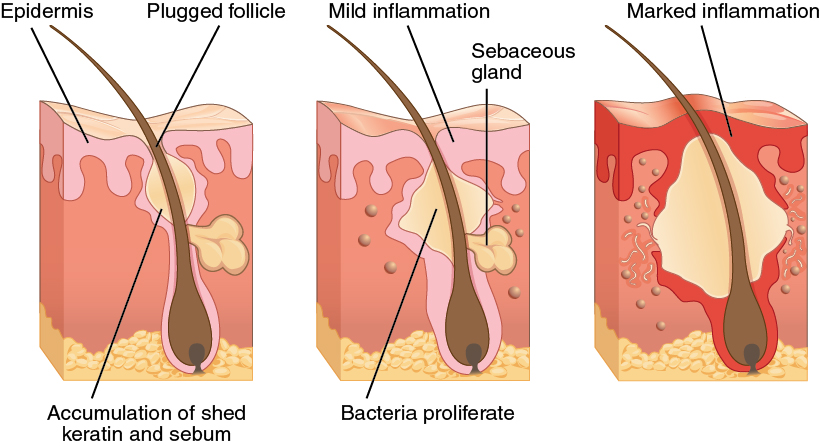
Acne occurs when the hair follicles become plugged with oil and dead skin cells. Hair follicles are connected to sebaceous glands. These glands secrete an oily substance known as sebum to lubricate your hair and skin. When your body produces an excess amount of sebum and dead skin cells, the two can build up in the hair follicles and form together as a soft plug, creating an environment where bacteria can thrive.
This process causes an inflammatory response seen as papules (red bumps), pustules, and nodules. The bacteria also cause the formation of free fatty acids, which are irritants, increasing the inflammatory process in the follicle.
Normal Follicles
Sebum produced by the sebaceous gland combines with cells being sloughed off within the hair follicle and "fills up" the hair follicle. When the follicle is "full", the sebum spreads over the skin surface giving the skin an oily appearance. When this process works correctly, the skin is moisturized and remains healthy.
Sebum produced by the sebaceous gland combines with cells being sloughed off within the hair follicle and "fills up" the hair follicle. When the follicle is "full", the sebum spreads over the skin surface giving the skin an oily appearance. When this process works correctly, the skin is moisturized and remains healthy.
Obstructed Follicles
Problems arise when the sebum is trapped in the hair follicle. For reasons that are still unclear, some hair follicles become obstructed. The sebum is produced but gets trapped on the way out, and the cells that are normally sloughed off become "sticky", plugging up the follicle. The process of obstructing follicles is called comedogenesis. It causes some follicles to form a type of acne called comedones, also known as blackheads and whiteheads.
Problems arise when the sebum is trapped in the hair follicle. For reasons that are still unclear, some hair follicles become obstructed. The sebum is produced but gets trapped on the way out, and the cells that are normally sloughed off become "sticky", plugging up the follicle. The process of obstructing follicles is called comedogenesis. It causes some follicles to form a type of acne called comedones, also known as blackheads and whiteheads.

Hope this information helped you in understanding what causes acne. It definitely helped me.
Sources:
mayoclinic.org
About.com
commons.wikimedia.org
youngwomenshealth.org

No comments:
Post a Comment